
The Values on a Douglas County Property Record
Market value estimates what a parcel would bring in an open, competitive sale. Appraised value is the county's full-value estimate, while assessed value applies the Kansas class ratio to that figure. A sale price stands apart as evidence of an actual transaction.
| Value | What It Is | Where |
|---|---|---|
| Assessed value | Appraised value times class ratio | Appraiser card |
| Market / appraised value | County full-value estimate | Appraiser card |
| Last sale price | Recorded transaction evidence | Deed and sales detail |
| Land vs improvement | Separate appraisal components | Appraiser card |
Douglas County rolls several classes of real property into its tax base at fixed assessment percentages. Residential real property is assessed at 11.5 percent, while commercial and industrial property generally carries 25 percent. Agricultural land uses 30 percent of use value, and exempt property may show zero assessed value on the record.
The official sample parcel displays appraisal components and annual history.
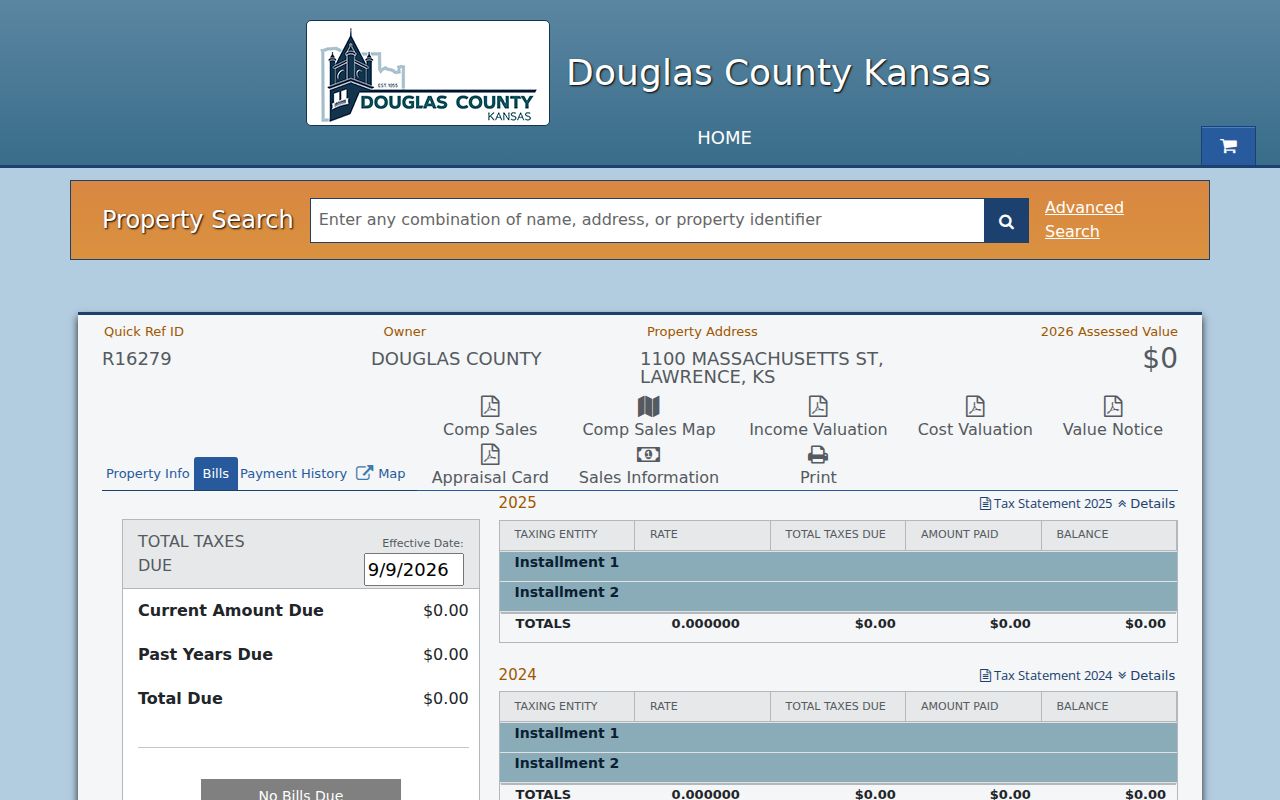
The exempt courthouse example makes the point plainly. Class and exemption must be read with the value itself.
Looking Up a Douglas County Property Value
Douglas County Market Study
The 2026 market study covered sales across the whole county. It reviewed more than 2,000 of them. Roughly 90 percent of residential and commercial parcels rose from 2025. Most increases landed between 1 and 8 percent. Treat the study as countywide context rather than a forecast for any single parcel.
Search Property Information by address or parcel key. Read the year, class, exemption, land, improvement, appraised, assessed, and history fields each on its own terms rather than as one number.
- Search the address in Property Information.
- Read appraised and assessed values for the correct year.
- Check the deed citation as sale evidence.
- Review comparable evidence when available.
- Assessed value
- Appraised value after the class ratio.
- Appraised value
- The county's full-value estimate.
- Assessment ratio
- The constitutional percentage for the class.
What a Douglas County Assessor Value Is Not
The assessor value is a mass-appraisal figure built for tax work. It is not an asking price, a replacement cost, a private appraisal, or a guaranteed sale price. One sale, by itself, does not control the appraisal.
Value vs price. An assessed value serves taxation and does not predict a sale.
Douglas County Value History
A Douglas County parcel card splits the value picture into land, improvements, total appraised value, assessed value, and year-by-year history. Keep the year and the valuation method attached to each number. A shift can come from market evidence. It can also come from a classification change, a new exemption, construction, or corrected parcel facts rather than from the market alone.
The historic courthouse sample illustrates the trap. It uses the cost method and carries a substantial appraised amount. Its assessed value is zero because it is exempt. That makes it useless as a residential ratio example.
Douglas County Sale Evidence
A recent purchase gets verified and weighed against comparable transactions. It does not automatically set the appraisal. A deed-history row may supply the date and book/page, while detailed sales information sits behind a separate access certification under K.S.A. 79-1437f.
Keep recorded consideration, sale price, market value, and assessed value separate. Each figure has a different source and purpose.
Douglas County Value Dates
January 1 sets the value date for every parcel in Douglas County. Appraisal notices generally go out around March 1. Parcel values refresh in November once the current tax year is calculated. Treat dated county notices as that year's schedule, not as permanent deadlines.
Value and classification questions belong with the Appraiser. Tax bills, payments, and delinquencies go to the Treasurer. The deed serves as recorded evidence of a sale. It is not the county's judgment of what a property is worth.