
Douglas County Deed Records and What They Show
The Register of Deeds indexes far more than deeds. Conveyances, releases, and many other instruments affecting a parcel all pass through the office, and a document's label never decides its legal effect, so read the recorded scan and any later corrections before relying on it.
| Deed Type | What It Does | Common Use |
|---|---|---|
| Warranty deed | Conveyance with stated warranties | Ordinary transfer |
| Quitclaim deed | Conveys whatever interest exists | Cleanup or related-party transfer |
| Transfer-on-death deed | Names a later beneficiary | Estate planning |
| Personal representative deed | Estate-authorized transfer | Probate matter |
| Tax deed | Tax-sale transfer | Delinquency process |
A deed records a transfer, nothing more. Mortgages, liens, easements, and releases record distinct interests or changes instead.
The Douglas County Grantor-Grantee Index
Landmark Deed Search Modes
Landmark Web handles six search modes. Name, Book/Page, Consideration, Record Date, Legal, and Quick Search each serve a purpose; before January 3, 1983, negative instrument numbers are placeholders, so preserve book and page citations and inspect the scan.
Start from the newest deed. Then search that deed's grantor as an earlier grantee, stepping back one transfer at a time while preserving each party's name, date, citation, and legal description along the way.
- Find the current purchase deed.
- Read the prior owner from the grantor line.
- Search that grantor as an earlier grantee.
- Resolve splits, replats, estates, and old books.
- Grantor
- Party giving the stated interest.
- Grantee
- Party receiving it.
- Chain of title
- Ordered sequence of recorded transfers.
- Book/Page
- Durable volume and page citation.
The Landmark entry screen leads into the official instrument index.
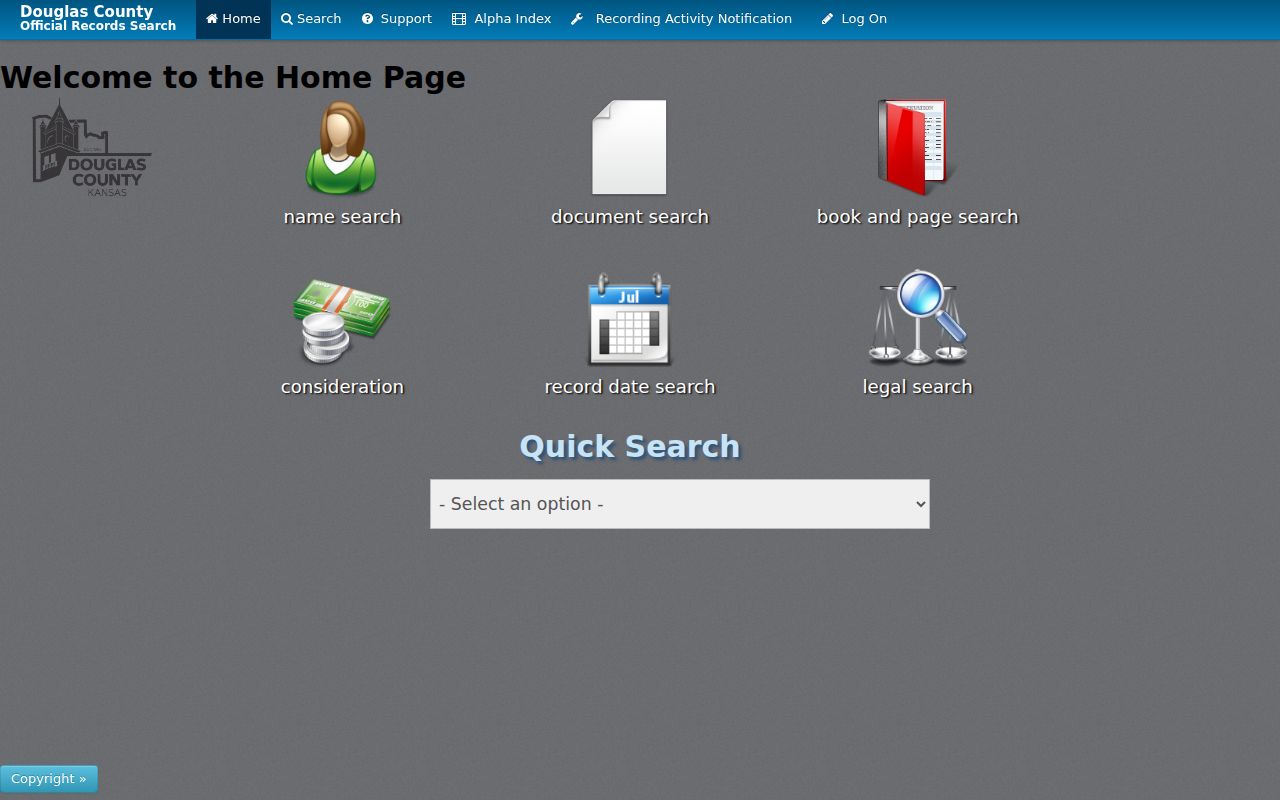
The captured screen is the starting point for party, date, book-page, and legal searches.
Getting a Copy of a Douglas County Deed
Search the public index online first. A Landmark account unlocks paid, non-watermarked images. Plain and certified copies remain available from the Register of Deeds, and scanned Deed Record A volumes, mortgage books, and index cards support work in older Douglas County deed records.
Recorded, not guaranteed. An index is not a title opinion. Read deeds, encumbrances, releases, court orders, and corrections.
Douglas County Legal Search Clues
Street addresses change; legal descriptions persist. A modern address may fail in a Douglas County property search. Try the abstract or subdivision name, block, tract, lot, and acreage instead. A plat can explain the road, easement, dedication, lot split, or replat. That record interrupts an otherwise simple chain of ownership. Municipal approval and county recording are separate steps. A Lawrence, Eudora, or Baldwin City planning file may document approval. Landmark holds the final recorded plat or ordinance. Match the two by date, subdivision name, ordinance number, and legal description.
Douglas County Historical Deed Access
The Register of Deeds publishes old deed volumes, mortgage-book directories, and subdivision index cards. Their presence proves little. Not every page is indexed or searchable, so record the folder, volume, page, and unresolved date range whenever an online chain stops. History does not stop at the county office. The Kansas State Archives catalog adds Douglas County deeds, liens, mortgages, probate, and court material in county series dating from 1857 to 1970. Lawrence Public Library and Watkins Museum help too. Their abstracts, maps, and newspapers explain old addition names.
Douglas County Deed Fraud Alerts
Douglas County offers a free Property Fraud Alert service for its deed records. You register a personal or business name and confirm through email. When a new recording matches that name, the system sends a notice right away. The county land records office runs the program.
The alert has limits worth knowing. It does not block a filing, judge whether a deed is forged, or settle priority between competing instruments. Think of it as a tripwire, not a shield, for the owner of record.
If an unknown filing shows up, act quickly. Save the instrument details, including the parcel number and recording reference. Then contact the Register of Deeds through its official page. Before paying any copy or retrieval charge, check it against the published county fee schedule.