
The county's historical index-card directory provides subdivision-based finding aids.
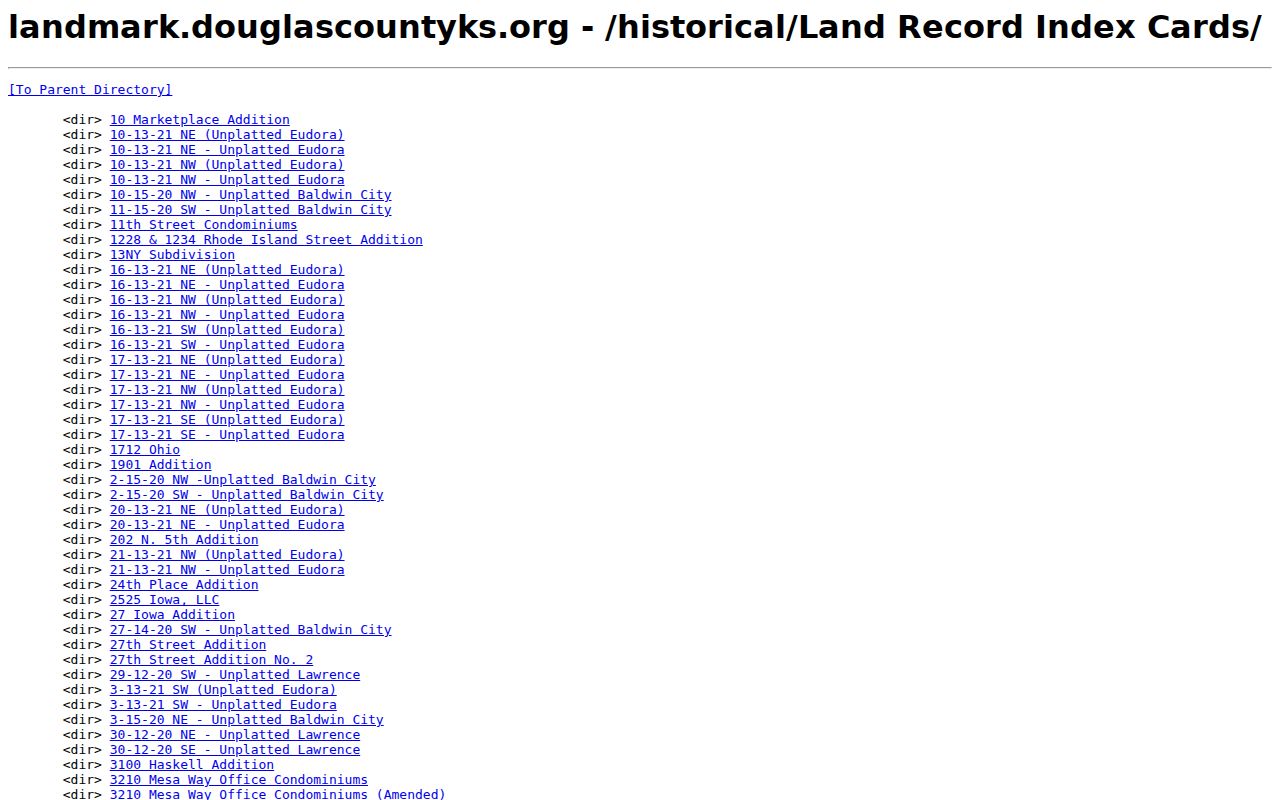
The folders can bridge a modern parcel to an older addition or book citation.
Douglas County Former Owner Sources
Begin with Landmark's modern party and deed index, which covers recent Douglas County deed records and current owners of record. As the chain ages, move to book/page citations, legal descriptions, scanned index cards, the older Deed Record volumes, and the mortgage books. The Kansas State Archives and the Lawrence Public Library hold microfilm, abstracts, plat maps, probate files, and local-history material that can fill gaps the county indexes leave open.
| Source | Years It Covers | Where Held | What It Shows |
|---|---|---|---|
| Landmark deed index | Modern index; full start year unstated | Register of Deeds | Parties, dates, book-page |
| Scanned deed books | Nineteenth century forward in named folders | Register of Deeds | Earlier instruments |
| Land index cards | Historic subdivision folders | Register of Deeds | Addition and plat bridge |
| Archive collections | County catalog, 1857-1970 | Kansas State Archives | Deeds, probate, court context |
Douglas County publishes no complete online coverage start year. So for deeds recorded before January 3, 1983, treat a negative instrument number as a placeholder only, and rely on book and page plus the scanned deed itself as the stronger keys.
Douglas County Deed Chain Timeline
Log every transfer fully. Each deed entry should capture the grantor, the grantee, the deed type, any signed and recorded dates shown, book and page, instrument number, legal description, the consideration if it was indexed, and later corrections. A replat, a parcel split, a transfer on death, or a personal-representative deed is really a branch, not a link, and each branch deserves its own property records source.
Walk Douglas County Ownership Backward
Start from the newest deed and read the grantor's name. Then search that name as a grantee in earlier property records, repeating the hop backward until the chain reaches the date you want or stops cold at a documented gap in the Douglas County deed records.
- Find the present owner's purchase deed.
- Copy the prior owner from its grantor line.
- Search that party as an earlier grantee.
- Continue with book/page and historical scans when needed.
- Grantor / grantee
- The party giving and the party receiving an interest.
- Chain of title
- The ordered sequence of recorded transfers.
- Legal description
- The land wording that survives address and parcel-number changes.
Douglas County Courthouse Parcel History
The courthouse's current card for the parcel cites a warranty deed dated February 11, 1902, at book 69, page 320. That single line ties a modern parcel to a very old transfer. Still, the deed scan itself remains the authority for what the transaction actually said.
Depth of Douglas County Ownership Records
Scanned deed books stretch Douglas County property records back past the reach of the modern portal. Index-card directories reach back just as far. Coverage online is not complete, though, and the county makes no promise that it is. A chain of ownership that stops at a parent tract is unfinished. You must resolve the lot split or replat that created the parcel. State land records can also help. A patent or tract-book entry may sit behind the earliest Douglas County deed.
Lawful use. Research prior owners for title, estate, property history, or civic purposes, never harassment.
Douglas County Book-Page Bridge
In older Douglas County deed records, the book and page citation matters more than a pre-1983 instrument number. Negative-numbered instruments were not assigned reliably before then. Search by party, date, deed type, and legal description. Pull the scanned volume for the full text. When a deed is missing, note the gap and keep looking. A compressed gap becomes a guessed owner of record, and guesses break the chain.
Chains break at parent tracts, lot splits, replats, annexations, probate transfers, and entity-name changes. Resolve that event before following the next grantor. Otherwise the tax roll and deed records will appear to disagree.
Douglas County Probate Transfers
Former owners surface in many places. Wills, estate inventories, final accountings, court orders, and death certificates can all carry a Douglas County parcel to a new owner of record. Transfer-on-death deeds and personal-representative deeds can too. The Seventh Judicial District case trail establishes the authority for the transfer. Landmark holds whatever instrument was actually recorded.
Portal access requires registration and a CAPTCHA step, and some attachments stay private. Courthouse computers remain a reliable fallback once you know the case or order you need. A focused records request to the clerk works as well.
Douglas County Historical Archives
The Kansas Historical Society catalog lists Douglas County records reaching back to 1857. The catalog runs through 1970. Deeds, mortgages, liens, court files, and probate series all appear in that span. Tract books there are arranged by legal description rather than by owner. So nail down the section, township, and range before you dig in. Lawrence Public Library and the Watkins Museum round out the picture with property abstracts, maps, newspapers, and other local collections. These add helpful context and finding aids. Still, a recorded or certified instrument carries more weight as evidence of a transfer than any historical summary. For Douglas County property records purposes, treat these archives as a starting point. They are not the final word.