
Read Douglas County Property Tax Records
The Property Information card gathers the essentials in one place. It lists parcel identifiers, class, appraised and assessed value, bills, and payment history. Appraised value reflects the county's estimate of market value at 100 percent. Assessed value then applies the constitutional percentage set for that class. The Treasurer record takes it from there. It adds the mill levy and the individual bill components.
| Field | What It Shows | Where |
|---|---|---|
| Assessed value | Appraised value after class ratio | Appraiser |
| Market / appraised value | County full-value estimate | Appraiser |
| Exemption and class | Reason assessed and appraised may differ | Appraiser |
| Tax bill and status | Charges, installments, payments | Treasurer |
| Taxing unit | Jurisdictions applied to the parcel | Parcel card and bill |
Kansas sets class percentages by law. Residential real property is assessed at 11.5 percent of appraised value. Commercial and industrial property generally sits at 25 percent. Agricultural land is assessed at 30 percent of use value rather than market value. One quirk is worth knowing. Exempt parcels can carry an appraised value while showing zero assessed value.
Appraiser and Treasurer Roles
Two portals cover the ground. The Douglas County Appraiser portal holds the value and classification record, and the Treasurer holds bill, payment, and delinquency information. Carry the same Quick Ref ID, tax ID, PIN, and situs across both sources so the records line up. January 1 is the annual valuation date. Value notices generally go out around March 1, and appraisal values refresh in November after the current tax year is calculated. Those dates describe the calendar the office follows. They do not state a fixed deed-to-roll update lag.
Look Up Douglas County Tax Bills
Start in Property Information. Search by address or parcel key, open the matching active real-property card, and review the Bills and Payment History sections. Before treating any displayed amount as current, confirm both the tax year and the installment.
- Search Property Information by address, Quick Ref ID, or tax ID.
- Read the bill year, installments, and payment history.
- Check the Appraiser class and exemption fields.
- Ask the Treasurer to confirm delinquency or sale status.
- Assessed value
- Appraised value after the Kansas class ratio.
- Mill levy
- Tax rate applied to assessed value.
- Exemption
- A legal reduction or exclusion reflected on the parcel.
- Tax lien
- A recorded or statutory claim tied to unpaid tax.
The county's appeal instructions separate an informal value appeal from Payment Under Protest.
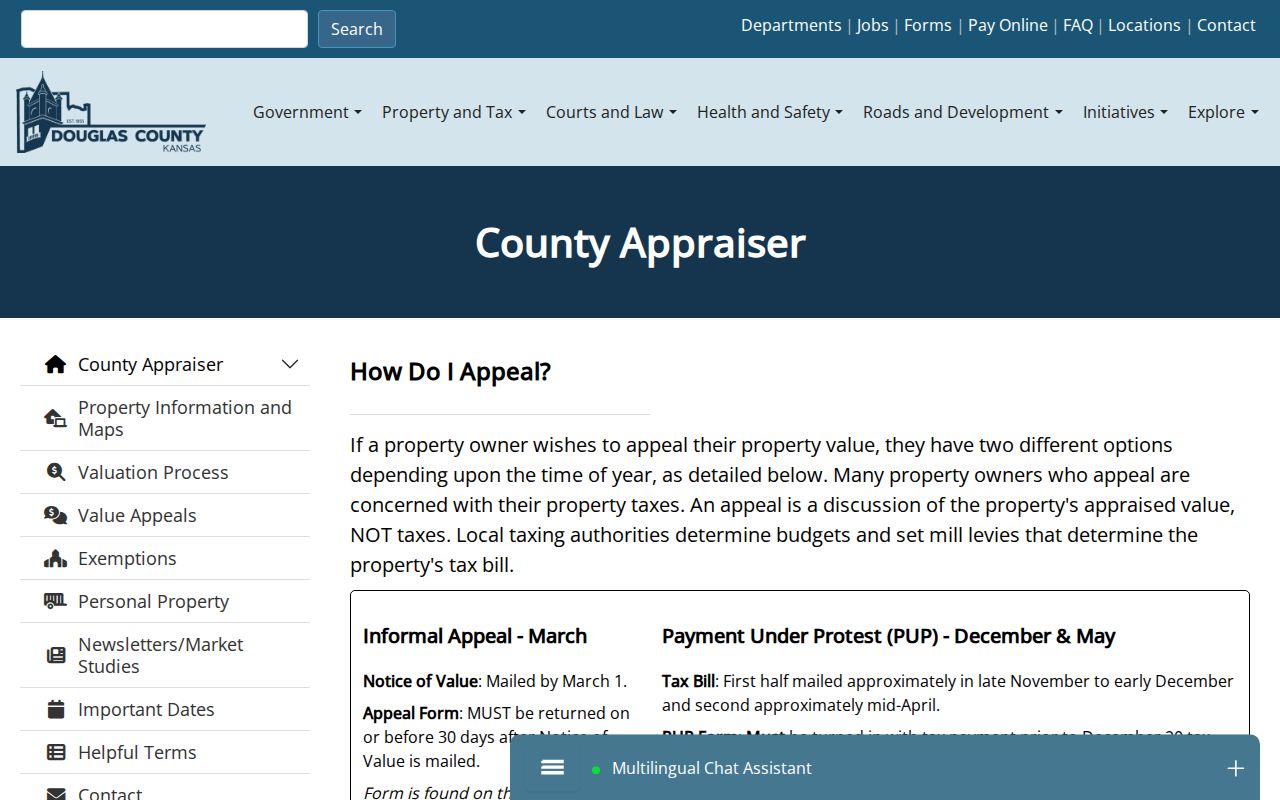
The captured guidance helps identify the right process and evidence for the tax year.
Douglas County Market Study Context
The 2026 county study offers useful context. It reviewed more than 2,000 sales and reported that about 90 percent of residential and commercial parcels rose from 2025, with most increases falling between 1 and 8 percent. Vacant-land and agricultural patterns moved differently. Keep the scale in mind: these are countywide study findings, not a conclusion about any single parcel.
Appeal a Douglas County Assessment
The Appraiser appeals page separates the informal value appeal from Payment Under Protest. A notice recipient generally has 30 days after mailing for the informal route. Good evidence varies. It can include photos, comparable sales, a contract, a private appraisal, a broker price opinion, a repair estimate, or an inspection report. Income property and agricultural land call for different supporting records.
Appeal window. Informal appeals generally must be filed within 30 days after the value notice is mailed with the Douglas County Appraiser; missing the window may require another available appeal route.
Douglas County Tax Payment Timing
The county calendar runs on two main dates. First-half taxes are commonly due December 20. The second half of the prior year's taxes falls on May 10. Online payments show up in the system on the next business day. Confirm the tax year and the current county notice before relying on any date. The portal allows payment for up to ten parcels at once. Its posted charges include a $1 eCheck fee per transaction. Card charges run 2.35 percent with a 50-cent minimum. A returned-payment charge costs $30. Fees can change, so verify them in the Treasurer source.
Douglas County Delinquent Tax Records
An unpaid bill can snowball. A delinquent tax bill may lead to a tax lien and, through a separate process, a tax sale, but a delinquency alone does not show that title has already transferred. The Treasurer describes sales as irregular rather than tied to one annual schedule. For a concrete example, a county notice dated July 9, 2026 set an August 12, 2026 sheriff's sale at the historic courthouse. Treat that as a dated event. For any specific property, check the parcel, legal description, charges, notice, later deed, release, and confirmation.
Douglas County Appeal Evidence
Proof follows property class. A residential appeal may lean on photos and comparable sales. It may also use a purchase contract, a private appraisal, a broker opinion, an inspection report, or a repair estimate. Income property may require three years of income and expense records plus a rent roll. Agricultural land can call for production data and sales records. It may also need inputs, leases, the legal description, and the PIN. Vacant land evidence might include zoning, planning records, site or topographic plans, and cost estimates. Remember the division of labor: the Appraiser decides value. The Treasurer does not conduct the valuation review.